

Descriptive Elements In Yoruba Palace Architecture and Cultural Values of the new Olubadan Palace
September 14, 2025
Religion made the noise, India did the work and Nigeria paid the price
January 6, 2026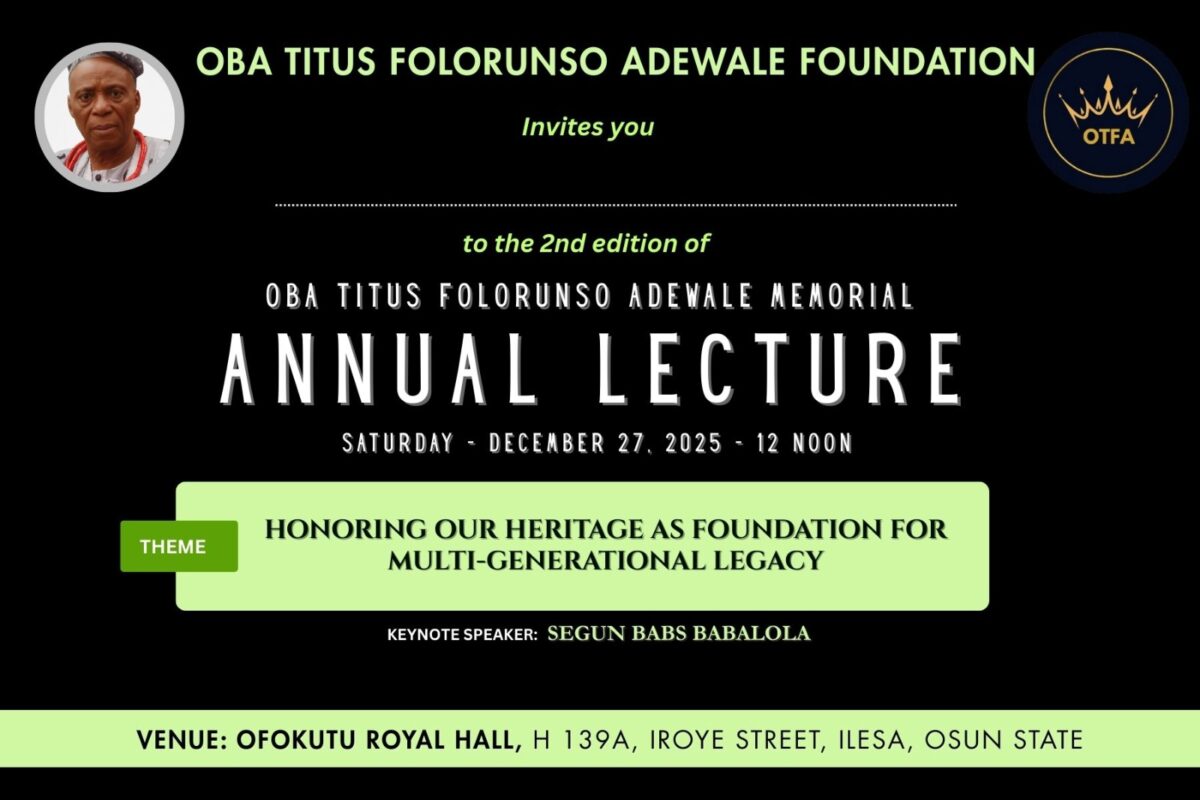
By Olusegun R. Babalola
Mo ki Egun-Ile, mosi ki orisha-oja. I commend this great Famoyin Ofoluku family for this great occasion and
humbly recognize all the elders on the high table; the Olori Ebi, Prince Olusanya Victor Adewale , Oba Adewale Oluwabukunmi Alowolodu II, the Ajeuba of Ijeuba; Prince Francis Adewale, Princess Omolola Adewale and Princess Adenike Adewale . I greet you all, sons and daughters, elders, youths, and keepers of our ancient wisdom. I am so honoured to be here. And the topic you have chosen, I must confess is for all the children of Oduduwa and not for only the people here. It is a topic that will echo in our history.
Today, I speak to you as one woven into the fabric of our people, drawing from the profound depths of our
civilization. What is the is the intellectual cornerstone of our heritage? Ifa, with its 256 Odu and countless
Ese (verses), is the intellectual cornerstone of our heritage, teaching us how to align with the rhythms of
existence for prosperity and good governance that endures across generations. Therefore, our topic,
“Honoring Our Heritage as Foundation for Multi-Generational Wealth and Legacy,” centers on Ifa—not as a
religion, but as our timeless knowledge system, a repository of philosophy, ethics, ontology, epistemology
and aesthetic that has sustained us since even before the days of Oduduwa.
On the subject matter of our heritage, I would start with few Ifa philosophical propositions which I would be
referring to in this lecture.
- On Ori-inu and Iwa – Most importantly Ifa teaches us about Ori-inu and Iwa, the two primal binaries.
Ori represents one’s inner spiritual essence and earthly purpose, the ultimate guide surpassing even
deities—”Ori la ba bo, a ba f’orisa sile” (It is the Ori that we should attend to, the orishas are to be
left aside). Socrates emphasized this in another way- “Know thyself.” As a result, we say orilonise.
Iwa has double meaning; good character and being – to be) is about virtues, about the moral
compass. The same virtues the Socratics spoke about. From Iwa we get many phrases; “Iwarere ni
eso eniyan,” “Iwà lẹsìn” (Character is religion)—shaping how destiny unfolds and Iwalewa, that is,
Iwa, which serves ori is beauty. Both ori-inu and iwa are intertwined: Ori sets the path, but Iwa
determines its navigation; without good character and being, even a favorable destiny falters. And as
Ifa tells there is no bad head in Otu-Ife, it is Iwa that is most important. Odu Ogbe Alara and Odu
Obara Meji speak of Orunimila representing ori and his wife Iwa. - On Wealth, Family and Ire Gbogbo – Ifa even defines wealth as aje in connection to ori and iwa. For
example, and “Ìwà lọba àwúre” (Good character is the secret for market sales). From Odu Ogbe-Alara,
we learn that “Iwa, iwa la nwa o, iwa/Bo o lowo lowo, to o niwa/Owo olowo ni o ni. (Good character,
good character is what we seek. If you have money but lack good character, the money belongs to
someone else.) It goes on to say the same for home, wife, children etc. Several Odus in Ifa
emphasizes the quest for wealth, peace, long life, honor, a home, wives, children who would extend
family’s wealth and honor, often as a combination as ire gbogbo. A verse from Odu Òdí Ogbè
illustrates longevity as the bridge to wealth: “If we live long, we shall become rich. If we grow old, we
shall become wealthy. For this Ifa emphasizes that we should know ourselves (ori), and we should achieve our potentialities with iwa, which means hard work, ethical conduct, exertion and no
shortcuts. - Market – From Ifa, we learn about the importance of the market within the city. Ifá links good
governance the management of a multitude of ori through Iwa, viewing markets as microcosms of
society where ethical leadership ensures prosperity. Cities and markets are established under Ifá’s
guidance, with symbols like odù dictating structure for harmony between human and nature.
Thriving markets require fair pricing, character-driven oversight by leaders (e.g., Ọlọ́jà the king, and
the Ìyálọ́jà), towards economic sustainability and most especially the perfection of several ori. - On relationship between Husband and Wife. Ifa speaks of the etymology of Iyawo, in Odu Obara Meji
which is the suffering, virtue, labour and patience of Orunmila in Iwo. The name of his wife, the
princess of Iwo is Iwa. In the Yoruba knowledge system of Ifá, Iyawo refers to a wife or bride,
embodying roles of partnership, legacy-building, and harmony within the family structure. Ifá views
marriage as a union aligned with Ori-Inu and Iwa, where responsibilities must be upheld to avoid
imbalance. - On monogamy and polygamy. In Odu Oyeku Meji Ifa says Ikan so so ni obirin dun mo ni’le oko. He
recounts the negatives things that would happen with many wives and that whilst polygamy may be
prescribed by one’s ori, it demands exceptional responsibility to prevent household disharmony. This
emphasizes that polygamy is permissible but requires honesty, equal care, and structure to expand
legacy without chaos. It is not an excuse for promiscuity but a deliberate choice for those capable of
sustaining multiple partners emotionally, financially, and spiritually. Monogamy, while not explicitly
mandated, is presented as a viable path, especially when polygamy risks envy or discord. Ifá does not
prohibit either but warns of consequences through verses that highlight potential pitfalls.
We will divide our exploration into two realms: the state, through the continuity of our civilizational heritage
in local government administration, constitution-making, and constitutionalism; and the society, through
family-based generational wealth and legacy.
Part 1: Honoring Heritage in Society – The Family as Cradle of Generational Wealth and Legacy, Grounded
in Ifa
My people, let us begin at the hearth, where heritage is first kindled – the society. In our society, the family is
the seedbed of wealth and legacy, passing down not just land or gold, but values, skills, and resilience. We
have seen that Ifa teaches that the family is the first vessel of heritage, where knowledge flows, nourishing
multi-generational wealth. We have seen that true wealth—money, children, homes—hinges on Iwa,
cultivated in the family to ensure legacy.
In our society, families honor this by transmitting Ifa’s wisdom and particular family traditions: Parents
depended on Odu for their own success and the successes of their children. The most important thing is to
ask – what was I made for? What is my purpose? Here, Ifa counsels patience and exertion (ebo) to build
family empires—farms, trades, knowledge—that grandchildren inherit.
How do we apply what we have learned from Ifa to families today? Our modern women hate polygamy,
thanks to Western influence. When a man whose ori accommodates several wives to succeed takes up another wife, the modern lady would say her man is cheating on her. Also, several men without the necessary skills have married many wives leading to disharmony. Yes, the breakdown of the Agbo-Ile system which could have provided a school for harmony has made it worse. We all now live in detached houses fenced with others on the street we are not related to.
Not only has the breakdown of Agbo-Ile affected marriages, it has also affected the bond between kins
(siblings and cousins), emphasizing individualism and creating deep chasm between them as they all grapple
with their egos, in a mortal competition for wealth and honour. What is affected most by this fragmentation
is the quality of education we give our children. We groom them without love for their cities, putting also on
them the yoke of individualism and ego.
How do we overcome these; marriage disharmony which has led to several deaths, and reckless individualism
destroying family bonds? These have led and are leading to wastages of human talents necessary for creation
of generational wealth. How do we reverse all these in our age of social media, regardless of the collapse of
Agbo-Ile? Maybe I should create an app for this for my generational wealth.
Strongly, I believe that the wisdom Ifa, some of which I have expressed above, can fix all these issues. Know
yourself before marriage. Don’t be too rigid about monogamy. Men should learn about polygamous skills
before plunging into it. Irosun Meji says Ka f’ owo we owo ni owo fin mo (We clean our hands when the right
hand washes the left and vise-versa). Odu Ofun-Ko says “Orunmila ni ki awon omo oun/Ma fi ogun
di’gun …Ma fi oro ya’oro …Ma fi ibi san ibi (Orunmila told his children/Do not use war to confront war or
wicked to confront wickedness or evil to confront evil). Obiriìn so wa nu, o ni oun o loriì oko (She threw away
Iwa, and complains that her ori has not chosen a husband). We can also change the pronoun and say okurin
so wa nu o loun o lori aya (He threw away Iwa, and complains that his ori has not chosen a wife).
Also when we all know ourselves (our ori), with our diverse powers, we can combine as a family to do great
things. Igi kan kii da igbo se (One tree cannot make a forest). Agbajo owo la fi n so ‘ya, owo kan o gberu dori
(Together, bonded, we can all be confident). Ka rin ka po, yiìye lo un yeni (It pays to do task collectively)..
Most important is the re-education of our children – Without it, as the proverb warns, Omo ti a o ko lo un gbe
ile ta ko ta. (A prodigious child is bound to dispose of his parents’ properties.). Odu Oturupon-Oworin advises
us to educate the youth on a daily basis to avoid a foolish life. Another Ifa says; Eniyan po, won o gban, Ifa ni
ka fi won we yunmuyunmu ninu oko (A mass of multitude without wisdom, let s compare them with insects
in the forest). If there is something Ifa hates, it’s folly and the refusal to use one’s brain. Àgbà kì í wà lojà kórí
ọmọ titun wo (An elder who is not present at a market permits
a child’s head to rest askew). The proverb Ko omo re ki o le fun o ni isimi (Teach your child to give you rest)
urges us to train our children early, instilling discipline and knowledge so they can sustain and grow the
family’s fortune. In our society, if we fail to teach our children Yoruba values like ori and iwa, our generational
wealth risks erosion through extravagance or disconnection. Omo ti o ba ma je Asamu, ati kékeré ló ti ńṣẹnu
ṣámú-ṣámú (A child that will turn out to be peerless, it is from childhood that he or she distinguishes himself
or herself)
Globally, this resonates. Take the Rockefeller family in America, who rose from oil tycoons in the 19th
century to philanthropists whose wealth funds universities and health initiatives across generations. John D.
Rockefeller honored his modest heritage by emphasizing frugality and strategic giving. The Rothschild family
in Europe honored their Jewish heritage of financial prudence. In Asia, the Tata family of India has honored
their Parsi heritage by transforming a trading firm into a conglomerate spanning steel to software, employing
millions and funding social causes—proving that family-based heritage, when honored, creates wealth that
outlives individuals. In India, the Ambani family has transformed oil refining into tech conglomerates, passing
knowledge generationally. We need families like these too
This was not new to our ancestors. Families have historically preserved wealth through generational
continuity; by passing on the art of farming, the technology of inks for adire cloth, the secrets of herbal
medicine, the calculating acumen of trading … etc. This is not accidental; it is deliberate honoring of heritage.
We have to use this heritage to break new barriers in science and technology, in AI. We need research hubs
in every city. We need to create tech hubs, train our children about coding. We need to revisit light and heavy
manufacturing and focus primarily on adding values to our raw materials. There are so many things,
manufactured things, we can sell to the world. This must be strategic, identifying what the global market
needs. Why can’t we also plunge into this solar tech. In all these we should leverage on our indigenous
knowledge is science and tech, pharmacy, agriculture, metallurgy, fashion, food processing … etc.
Honoring this heritage, families can invest in education and businesses, turning modest beginnings into
empires that benefit grandchildren yet unborn.
Part 2: Honoring Heritage in the State – Continuity of Civilizational Heritage in Local Government
Administration, Constitution-Making, and Constitutionalism, Anchored in Ifa
Now, let us broaden our gaze to the State, where honoring heritage ensures the continuity of our civilization.
In our tradition governance was never abstract; it flowed from our heritage of mixed government between
the Oba as the monarch, the Chiefs of lineages and Elders like Ogboni were the aristocracy and the people
represented democracy. The most important in all are the wisdom of the leaders especially, the philosopher
king and the aristocracy that is the watchdog of the rule of law, which are also accommodated in Ifa. Both are
emphasized in Odu Ifa Owonrin Meji.
Ifa provides the blueprint for governance, ensuring our civilizational heritage endures through local
administration, constitution-making, and constitutionalism. As a knowledge system, Ifa offers ethical
frameworks for leadership, justice, and continuity, much like unwritten constitutions guiding obas and
councils. Just as every individual every city has an Odu that defines the ori of the city. From Iwori Meji we
learn that agbo ejo enikan da, agba o sika (Judgement without fair hearing from both sides is wickedness). It
is such fairness, useful now in Customary Jurisprudence, that our heritage encouraged to manage several oris
in the city, that people may achieve excellence and happiness through their ori.
For constitutionalism, that is, how the constitution is made to work, Ifa’s emphasis on truth in Odu Ọsa
Otura—”Truth is the Lord of Heaven guiding the Earth… Speak the truth, tell the facts; Those who speak the truth are those whom the gods will help”—demands laws that uphold ethical governance, ensuring civilizational continuity against corruption. According to this Odu, Ifa itself is the Truth. Ifa also emphasizes the wisdom, justice, courage and responsibility (Iwa) necessary for the political class lead by the Oba to rule not only over the city, but also market. That is where the term Oloja comes from.
As is universally celebrated, Ifa accommodates what is called binary complementarity; for example, between
female and male, the lead and the leader, ideology and traditions or civilization, constitution and
constitutionalism, iwa and ori, the oja market and the most important house, the palace, Aafin; Iyaloja and
Oloja … etc. This binary system is symbolized in the city with the oja-oba (king’s market) controlled by our
mothers and the Aafin (palace) controlled by our fathers at the center.
The market is the place of the short-term ideology whilst the Aafin anchors the long-term civilization, making
sure that the concern for money does not destroy civilization – concern for Iwa and Ori. It is this civilization
built on the imitation of nature that we call Isese. Odu Ogunda Ose tells us “Isese lo’ma l’eke/Isese lo ma gbe
niyan” (Isese wins/Ises pays the human being). This is fundamentally, how generational wealth is connected
to heritage.
In this way with several other things Ifa teaches, the constitutions and constitutionalism of our cities embed
our civilizational essence, ensuring legacy for the nation. In our civilization, continuity meant that each oba
built upon the last, and this is constitutionalism in action: unwritten rules of respect for ancestors ensuring
stability. This in itself is a form of capital.
Globally, parallels abound. In New Zealand, the Treaty of Waitangi is woven into constitutionalism, honoring
Maori heritage through land rights and bilingual laws, fostering economic legacy via tribal enterprises,
mandating local consultations in local governance. In Bolivia, the 2009 plurinational constitution honors
indigenous knowledge systems, embedding communal decision-making. This has preserved cultural wealth
and empowered generations against exploitation Even in Japan, the post-war constitution retains elements
of Shinto heritage in emperor symbolism, ensuring civilizational continuity amid modernity—echoing our
proverb Ilé ọba tójó ẹwà ló bùsi (The king’s palace that got burnt added beauty to it; every cloud has a silver
lining), where challenges refine heritage.
Most importantly, Chine rise is connected to what Deng Xiaoping called “Socialism with Chinese
Characteristics,” whist characteristics is based on Confucius, a Chinese equivalent of Orunmila. Note, two
things here; an ideology and a civilization. United States too employs Capitalism with Western civilization,
with Western civilization made up of pagan Greco-Roman and Judea-Christian heritages. Have you ever
wondered why the most important buildings in Washington D.C. are Greco-Roman classical buildings evoking
the wisdom of those classical pagans? One of these pagans, like Socrates is in the Catholic Church refers to as
a pagan saint. Such interplay between ideology and civilization is not new to Russian, India as well as Japan as
earlier stated.
The question then is – in modern constitution-making as well as constitutionalism, why have we abandoned
our rich heritage found in Ifa classical philosophy?
We too must go back to the oja (ideology) and the Aafin (civilization)-our heritage- and devise the most
appropriate ideology for our time. That takes us back to the issue of restructuring. We need to re
constitutionalize our indigenous polities, our cities with our indigenous institutions into the modern
structures of local government administration, states and federal government. For example, on the issue of
State Police against on-going insecurity, the best way to secure a profitable and accountable system of state
police is to organize them based on fragmented polycentricity, under the natural rulers-in-council. Note, I am
not saying the natural rulers alone, but the oba-in-council (the monarch and aristocracy) for each unit. This is
the only way our heritage can be foundation for multi-generational wealth and legacy.
Constitution should guide the state back to its heritage roots. When we infuse our modern constitutions with
our heritage, we create a framework for multi-generational legacy, where the state becomes a guardian of
wealth like natural resources and cultural/tourist sites. Fortunately, this huge task is the job of the society
and not the state.
Conclusion: A Call to Honor Ifa and Forge Enduring Legacies
My brothers and sisters, fathers and mothers, honoring our heritage through Ifa as a knowledge system—the
ultimate knowledge system—is the unyielding and unbreakable foundation for multi-generational wealth and
legacy. In society, families bloom with Ori and Iwa; in the state, governance endures through just
constitution(s) to manage ori and regulate iwa.
As we navigate the modern world, let us remember that our ancestors built several great city-states like
Ilesha, Ile-Ife, Akure, Owo, Edo, Ijebu … etc, where kings-in-council ruled with the guidance of Ifa, and
communities thrived through shared values. Honoring our heritage is not mere nostalgia; it is the bedrock for
building wealth that spans generations and a legacy that echoes through time. So, let us embrace the
continuity of our civilizational heritage in the society and in the modern state, in our constitution-making and
constitutionalism.
It is what we sow or plant that we reap. Bí a kò ránni sojà, ọjà kì í ránni sílé. If one does not send a message
to the market, the market does not send a message to one at home. (Without making an effort,
one cannot expect rewards.) This teaches us that what we give to heritage returns manifold. Let us respect
Ifa as our heritage, teach our youth, and infuse our laws with its wisdom, drawing from global examples to
strengthen our path. In this, we fulfill Oduduwa’s vision, where, as one Ifa verse echoes, long life brings
wealth for all. In doing so, we fulfill the ancestors’ vision, building a legacy where, as one African proverb
echoes—though rooted in our wisdom—when a child is born, an ancestor returns. E se pupo, and may
Olodumare bless our endeavors.