

Narrative Power: Shaping Meaning, Identity, and Resistance
August 14, 2025
Honoring Our Heritage as Foundation for Multi-Generational Wealth and Legacy
December 28, 2025
By: ESV. Tomori Moshood A. anivs, rsv, mnim, arva
THE YORUBA PLACE IN HISTORY:
Usually, the first public facility constructed in every royal city was the palace. For this, an effort was usually made to find a distinctive location, normally a low hill around which the new city could evolve. In many kingdoms, the main palace buildings were surrounded by many acres of ground, most of which was left under virgin forest. A wall (known as gbagede) was then built to surround the palace and its grounds, with access through one large gate. It was a measure of a king’s success that he added to, or improved upon, the palace buildings, especially its gate structure. As a result, the growth of the palace constitutes an important Yoruba kingdoms. The biggest and most powerful kingdoms had the most impressive palaces.
According to Professor S. Adebanji Akintoye (2010), Imade built the first Owo palace on the low hill known as Oke Asegbo (Asegbo Hill), where the OwoCity Hall now stands. His successors moved it to a better location on Oke Ekusi
(Ekusi Hill) where it now stands. Awamaro built the Ado (Ekiti) palace on the gently rising hill known as Oke-Adodo, where it served as the hub linking the group of quarters of the old settlers (at Odo-Ado) and those of the immigrants (at Oke-Ewi), and where it stands today. The Ijebu kingdom of Ofin built the Akarigbo’s palace on Oko hill, a beautiful location overlooking most of the royal town. In the hilltop city of Efon in Ekiti, the Alaaye’s palace was built on a distinct little peak.
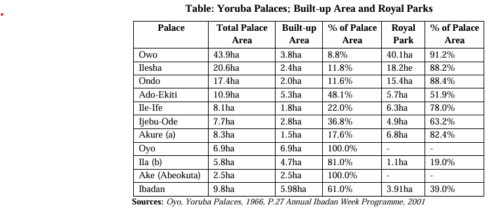
The present Oyo Palace, built in 1839 covering 6.9 hectares is said to be a replica of the classic destroyed in 1837. Its small size and triangular shape are due to the fact that it was erected on the heat and confusion of the civil wars and in an already built-up area (Ago Oja), a fact ataht explains its lack of the traditional royal park which normally constituted the greater part (roughly between 50 and 90 present) of the classic Yoruba palace ground.
No Yoruba palace, according to Oluremi I. Obateru (2006), has been able to withstand the test of the cultural metamorphosis. However, they are not all on the same level of cultural decay but at various stages of cultural transformation. At one end of the contium is Akure Palace which has abortively been resisting Western acculturation while at the other end is the Itoro palace of Ijebu-Ode which has completely disappeared and whose site has been taken over by several public buildings, religious, educational and residential uses. However, most of the palaces have not attained his terminal stage of extinction.
Due to neglect and disuse, many palace buildings have collapsed and disintegrated, some of which have been replaced by modern buildings; several have deliberately demolished and replaced by modern ones wither for the use of the royal households or for the use of the general public.
2.0 THE BUILT-UP AREA OF THE PALACE
The developed land of the palace is divisible into two areas: the public and residential areas. Land use specialization is a noteworthy feature of the Yoruba Palace. The various functions and activities of the Palace were segregated but they were not haphazardly sited. The ordered use of the Palace ground is based on the functional relationship of the apartments.
(a) Public Areas
The public areas were devoted to governmental activities, the most important being legislative, executive, judicial and administrative functions. The most important of the public areas were the courtyards for public assembly which is the front courtyard of the palace. It is used for the various public assembly purposes, religious ceremonies as well as political and socio-cultural
activities. Others are state Council meetings, public reception, entertainment and homage payment as well as those for religious purpose: religious worship and sacrifices, oracle consultation, Oath taking, and festivities.
(b) Residential Area
The residential area consists of the private apartments of the king; the private apartments of the king’s wives; the apartments of the princes and princesses; the apartments of the king’s retainers; and the apartment of solves.
(c) The Royal Park
The king’s park was the most extensive land-use element of the ancient Yoruba Palace. The park was a multi-purpose public establishment, however, such 19th Century cities as Oyo and Abeokuta lack palace parks but alternative areas are provided in their outskirts for royal recreation.
Secondly, the park was also a zoo where special and rare animals were conserved for medicinal purposes. It was a botanical garden where rare and special medicinal plants were cultivated and conserved.
Thirdly, it was a mausoleum, a place where deceased monarchs were buried. A small section of this park is set aside for this purpose.
3.0 LOCATION OF THE PALACE IN THE CITY
The position of the palace was invariably the city’s geographical centre or close to it as much as possible if there were physical constraint. The arteries of communication converge on it as the embodiment of the city and the foundation of city life. Exceptions were Abeokuta and Shagamu where you have more than one palace, this also include Igboho.
The sitting of the royal palace on an elevated land is not peculiar to the Yoruba city. Urban history, since the early dynastic periods in Mesopotamia, reveals that the palace and the great temple have almost everywhere been associated with low hills, or an extensive eminence in the city centre where the sheer magnitude and upward thrust of the palace usually dominated the rest of the city.
The hill in the ancient time was a military device. It was a natural fortress commonly walled to protect the king against enemies within the city and without. The Greeks associated the hill with kings, oligarchies and tyrants, and the lowland with democracy. (R.E. Wycherley on “How the Greeks Built Cities, P. 37).
Ibadan has no central palace because of its social system. The residences of the ruling class were always converted to a palace when they become the Bale or Olubadan. Those that resemble old Yoruba palace strctures in traditional architecture are the palaces of Oluyole, Alesinloye, Ogunmola, Foko and Irefin. The choice of the new Olubadan Palace at the slope of Sapati Hill at Oke-Aremo at the centre of the city is in line with Yoruba tradition for the following reasons;
(i) Apart from the environmental qualities, a hilltop or elevated landscape is a lookout a palace from which the surrounding urbanscape and the countryside beyond could be viewed.
(ii) A buildings erected on a hilltop was an eye-target for people as it was readily seen.
(iii) Eminences afforded their occupiers usually privacy, protection against overlooking by neighbouring residents.
(iv) Elevated grounds were well drained contrasting with low grounds and valleys which might be played by flooding, river pollution and diseases.
3.1 Shape and Size of Palace
The large size of ancient Yoruba palace was due to the fact that it was a public edifice, built and maintained not only by the population of the royal capital but also by the entire population of the kingdom. Consequently, the larger the populations of a kingdom the greater were the human and material resources available for its establishment and sustenance.
In terms of size and magnificence, the ancient Yoruba palace was the grandest residential unit in both the royal capital and its kingdom. The palace was a highly elaborate complex of the contemporary courtyard compounds.
According to Oluremi I. Obateru (2006), the palaces of Oyo built in 1839 covering 6.9 hectares and that of Abeokuta around 1830 are products of the civil strife. This is why they are relatively small in size; they also lack royal parks of Old Oyo and Owu covering about 259 hectares. The present day sizes of Yoruba palaces are: Ife total palace area cover about 8.1 hectares, Ijebu-Ode about 7.7 hectares; Akure about 8.3 hectares; Oyo about 6.9 hectares; Ila 5.8 hectares, Abeokuta (Ake) about 2.5 hectares. Out of these palaces, Oyo and Ake are fully built while others have Royal Parks of 78% for Ife; 63.2% for Ijebu-Ode; 82.4% for Akure; and 19.0% for Ila (Ojo, Yoruba Palaces, 1966, P. 27). Thus, of all the Yoruba Palaces, that of he present Oyo, 6.9 hectares, has the largest built-up area. However, the New Olubadan Palace has an area of 9.89 hectares with a built up are of 5.98 hectares, while the old Irefin palace in Ibadan was built on 4.0 Acres of land.
4.0 DECORATIVE ELEMENTS IN YORUBA PALACE ARCHITECTURE
Palace in Yorùbáland plays a significant role in the life of the Yorùbá people. As part of Yorùbá institutional buildings, palaces are held in high esteem by culture and the people. As such, palace shrines and rituals contributes to the authority they hold within the town, hence they are centrally located in the planning of Yorùbá towns. They are a place for public assembly and state gods or deities and final resting place of deceased obas. As all power and authority lead to the divine king so is the road network and paths converge towards the àfin. The àfin serves as the fountain to the culture and identity of the kingdom it governs over.
i) The Peremeter Wall Fence
The place of the palace in Yorùbá land cannot be overemphasized and they are institutional structures that have withstood the test of time despite introduction of modern ideology and technology of construction. Palaces are regarded emblems of what constitutes Yorùbá architecture and in entirety the culture of the people. Reflecting their belief system on the status and sacredness of the oba, the perimeter of the palace grounds is usually walled. Constructed of earth, they are usual about 3feet wide and up to 12 – 18 feet in height to retain its prominence. Though conspicuous, the wall provides a sense of privacy for the oba according to Yorùbá culture. The wall can be easily noticed from whichever direction the palace is approached since it is situated in the middle of the town (an example is the Alaafin’s palace in Oyo town).
Like every Yorùbá traditional architectural construction, the palace is a reflection of an intimate association with their vegetal environment as it reflects in the use of thatch and other vegetation in their roofing [9, 19]. Before contact with the west and introduction of new construction materials, Yorùbá palaces and houses were constructed to protect the people from the weather especially rain. As a result, more, attention is paid to making their structures rain proof. Adoption of the high-pitched roof allows for easy drain off of rain water. Same style roofing is adopted in a large scale for Yorùbá palaces.
The perimeter walls are often left bare and unfinished on purpose. It is left uncovered to inform the visitors and indigenes about the wealth surrounding the Yorùbá seat of power [12]. Different region have varied colour of laterite that ranges from cool reddish colour to lighter yellow that serves as identity marker. Besides the unfinished wall allows the visitor appreciate the good quality of laterite used for the construction. In some instances, the laterite elements used in constructing the wall is sometimes mixed with shear butter and palm oil instead of water thus, increasing the durability for much longer period.
ii) Oja Oba (Oja-abata)
Major architectural element of the Yorùbá palaces is the entrance gate called oju abata. Ojo argued that the gate is usually positioned along the side of the wall facing the marketplace known as oja-oba (king’s market). The idea of the oja oba directly opposite the entrance gate to the palace is a common feature in Yorùbá towns. This is evident in major palaces like that of the Alaafin of Oyo with an elaborately designed oju abata. Oju abata is not a mere gate or gateway but one that informs visitors about the history, identity and culture of the people as zoomorphic representations are used as decorative elements. According to Ojo oju abata is like a tunnel connecting the outer world of the town with the inner world of the palace. In some cases, oju abata opens to a large open space overlooking the inner palace wall that has the entrance to the palace. In other instances, it opens to a large courtyard that serves as a communal space for different activities.
iii) Courtyard
Courtyard forms one of the five major element of Yorùbá architecture. Their palaces consist of many courtyards (ka) of varied sizes for different functions. The biggest of the numerous courtyards is designed to break the massiveness of the built-up area of the palace. Sizes of the courtyards vary greatly from palace to palace and dependent on the expanse of land occupied by the palace. Palace of the Alaafin of Oyo in the past had 100 courtyards which has been reduce to expand the built-up area. The function of the courtyards within the Yorùbá palaces includes enhancement of private family cohesion, ventilation, lighting, food storage, stable for horses, space for settling disputes, and spaces for various deities to mention a few. The courtyards contribute to the division of spaces into zones and help maintain the private area from the public and semi-public zones. Multiplicity of courtyards (ka) within Yorùbá palace has become a common element of their traditional architectural design and planning.
iv) Palace Entrance Porches
Protruding from the main palace wall to either the major road or the main courtyard are several porches that serves as an architectural element of Yorùbá palaces [12]. The porches tend to break the monotony of the stretched rectangular shape The courtyards are surrounded by verandas with roof supported on earthen columns or carved wooden posts. Wooden posts are another important element of Yorùbá architecture. It is one element that also signifies status of the budling and the owner within the Yorùbá town. Carved posts in Yorùbá architecture are decorative elements that enhances the budling structurally and aesthetically.
v) Columns
The use of columns as architectural elements in Yorùbá palaces predates the contact with the west. The columns were used as structural elements in carrying roofs. The importance of the column is highlighted in the Yoruba proverb that distinct various uses and types of columns. They are usually carved with inscriptions and decorative motifs that tells a story and serves as tangible reminder of beliefs and culture. Such artistic skills are carried out by designated families known as the Olona who are carvers charged with the duty of carving. Their works included carved wooden veranda posts and carved wooden door panels, found in palaces and house of nobles. Such works are evident in Yoruba palaces as testaments to Yoruba artistic representation ingenuity and creativity. From the choice of hardwood to the distinct motifs demands a creative skill that is second to none.
Decorative and artistic taste of the Yorùbá people is determined by their environment, immediate society and their intangible spiritual orientation. As a result, Yorùbá architecture is emphasized through the use of decorative elements such as murals, motifs and carvings that indicates their religious affiliations, statusand financial capability.
Hence, the best of Yorùbá decorative elements is easily identified in palaces as the highest structure revered aside shrines. Long before colonization and influence, Yorùbá architectural main features are ornamentation in wood and carved motifs on doors and roof supports especially within palaces.
Ornamentation is reflected in architectural elements fabricated by woodcarvers such as veranda post, doors panels, facia boards, doors and windows. Murals are also common place on the walls of palaces where animals and objects connected to divinity of the obas are depicted. A good example is the oju abata to the Alaafin ofÀfins in Yorùbá land are built to house the whole community wealth, riches, cultural artifacts, beliefs and tradition that is reflected in the ornamentation [2]. Thus, the decorative and ornamental elements found in the Àfin (palace) are reflections of the rank and prestige of the Oba. This structural support though artistically finished are integral and functional element of the building [12]. However, as decorative elements, they constitute master pieces of Yorùbá carvings and depicts integral part of their culture. As a result, each carved posts tells a story as it is used to record events in the absence of writing. Thus, serve as visual markers of identity and culture. In modern Yorùbá architecture, traditional decorative mouldings and ornamentations are nearly eliminated, paving way for a clean aesthetic where materials such as wood, brick and stone are used unornamented. Hence, the tradition is gradually fading away as modern designs emerge.
5.0 THE IREFIN PALACE DECORATIVE ELEMENTS
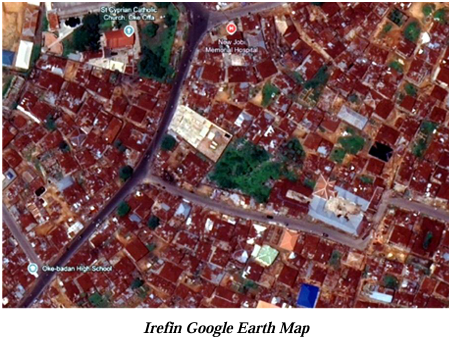
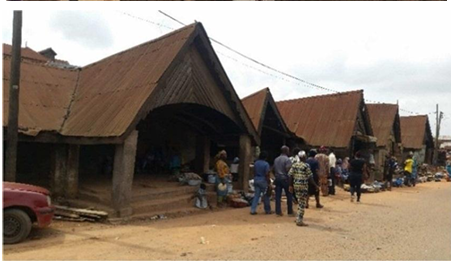
Àfin Irefin was built in the year 1910 on about 4 acres of land. It is an elaborate structure with 62 rooms contrary to 125 mentioned by the Oyo state government [14]. The four acre palace is bounded by Irefin oje road and Oke adu road. Today Àfin Irefin has lost most part of the palace grounds to remain only the palace structure. The palace structure constitutes four zones surrounding four courtyards with the largest measuring about 300sqm. It is situated on a hill top that allows a good view of surrounding landscape of Ibadan from the roof terrace. Bounded by Irefin Oje road by the side and the main entrance (Figure 1). Irefin Oje road can be accessed either through two major roads – Bashorun gate or oke adu road. The main entrance consists of five gable porches that serves as a market place (Figure 2). The market is in line with Yorùbá culture where the king’s market is before the palace. A position that further highlights the relationship between both institutions of authority where the market is a citadel of political power and the Oba is the Oloja and oversee all activity within it.
6.0 THE WINDS OF CULTURAL TRANSFORMATION
The basis of social, political and economic organizations in the traditionalsociety is traditional religion. Religion permeated every aspect of the society. Netonly the land and its resources but also the people belonged to the gods. Every actand every pronouncement of the divine rulers were regarded as coming from the gods.
However, more than other factors, foreign religions and education have dealta crippling, if not crushing blow on Yoruba traditional religion, social and political institutions. With the coming of Islam and Christianity, the letter in particular, to Yorubaland, the tight grip of traditional religion on the people began to loosen, and the myth of divine kingship began to dissolve.
The problem of neglect and disuse is compounded by the fact that the palaceis today no longer the principal focus of religious, social and political life of the city.Most of the palace functions have been taken over by such public establishments as churches, mosque, town halls, court houses, local council offices, sports ground among others. For instance, the Itoro palace of Ijebu-Ode has been taken over by several building of public, religious, educational and residential uses. However, most of the palaces have not attained this terminal stage of extinction.
Most of the Yoruba palaces have not been able to withstand the test of the cultural metamorphoses, or cultural decay, while some are at various stages of cultural transformation.
Due to neglect and disuse, many palace buildings have collapsed and have been replaced by modern buildings to befit both socio-political status of the Oba and keep abreast of cultural transformation. As pointed out earlier, the Yoruba Palace is functionally multi-purpose, most notable being residential, religious, governmental, industrial, socio-cultural, and recreational and storage.
7.0. THE PRESENT STATUS OF IBADAN
According to the UN-Habitat report of 2008, Ibadan located at the interface of savannah and forests and the capital of Oyo State, is the third largest city in Nigeria by population after Lagos and Kano. Ibadan is however, Nigeria’s largest
city in geographical area (3,146.98 sq.km) with eleven administratively separate Local Government area. In 1960, Ibadan was the second-most populous city in Nigeria and the tenth largest in Africa after Alexandra, Algeria, Cairo, Cape Town, Casablanca, Durban, East Rand, Johannesburg, and Lagos. It is located in south-western Nigeria, 140 kilometres inland from Lagos and constitutes a prominent transit point between the coastal region and the Nigerian hinterland to the North. Its population was 2.55 million according to the Nigerian 2006 census and 2.67 million in 2007. Ibadan had been the centres of administration of Nigeria’s old Western Region since the days of British colonial rule when Ibadan grew into an impressive and sprawling urban centre. Ibadanland now had 1 city, 63 Towns and 3,089 central villages.
In her praise for the book published by professor Toyin Falola (2012) titled: IBADAN: Foundation, Growth and Change; the Emeritus Professor Bolanle Awe described Ibadan as the largest indigenes African town south of the Sahara, has grown from its humble origin as a refugee settlement in the nineteenth century into a sprawling cosmopolitan city that is now home to many millions and serves as the intellectual capital of Nigeria. A city of contrasts, of tradition struggling with modernity and Ibadan’s unique history has engaged the attention of writers and scholars right from the nineteenth century to date.
8.0. THE NEED FOR A NEW OLUBADAN PALACE COMPLEX
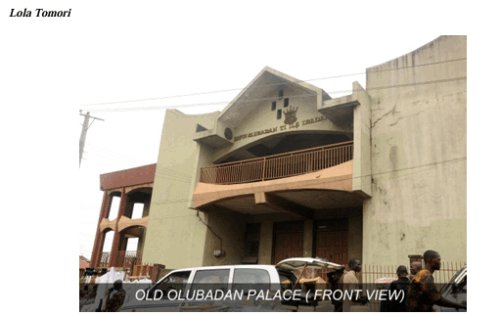
The old Olubadan Central Palace at Oja’ba is located close to Mapo Hall and Oja’ba Central Mosque in Ibadan South East Local Government and also very close to the central market established by the descendants of Lagelu as part of the second Ibadan.
The building of the first Olubadan Palace at Oja’ba is a reflection of cultural transformation of the Yoruba traditional, religious, social and political institutions. In the 1980s, according to Asiwaju Bode Amoo, Ibadan elites made efforts to construct a located at Oja’ba, in the centre of the town. Before then, each individual Olubadan lived in his personal house. Unfortunately, the Olubadan Palace had some inadequacies such as;
- That it is rather chucky for present day usage and because of constraint of
- space, it has no room for expansion
- That there is no open space for ceremonies and other out-door activities.
- That the environment falls short of a befitting Palace of the most populous, indigenous African city.
- Therefore, Oja’ba Palace serves only as an occasional meeting venue of the Olubadan Advisory Council and the meetings of the Association of Mogajis
Professor Toyin Falola (2012). In the exercise of power, the Baale was the Chief Executive. There were cases when the overall civil and military authorities were combined in one person (for instance, Oluyole, Ogunmola, Latosa) but when
the power was separated between the Baale and the Balogun, the former was supposed to preside at meetings.
8.1. Accessibility Evaluation Criteria Required;
- Availability of sizeable land that has no other development plans areconsidered for the same land
- The site has a suitable topography for building a befitting New
- Olubadan Palace on a gentle slope (if possible), that is the change in elevation is rather gradual similar to the location of palaces.
- The location of the site must be close to the central area of the city that is accessible from all directions to the in habitants and visitors to the palace.
- The location is close to water and electricity resources
- Identification of the main features of the new Olubadan PalaceComplex location
- Environment Impact Assessment.
Detailed plans and engineering designs have been made for the Olubadan Palace and Ibadan House, including other various infrastructure facilities, such as the road system, the sanitation, drainage, electricity, drinking water supply systems, police station and car-parks.
Unfortunately, all of the above mentioned studies were carried out using
traditional procedures without any involvement of Geographic Information System
(GIS) analysis.
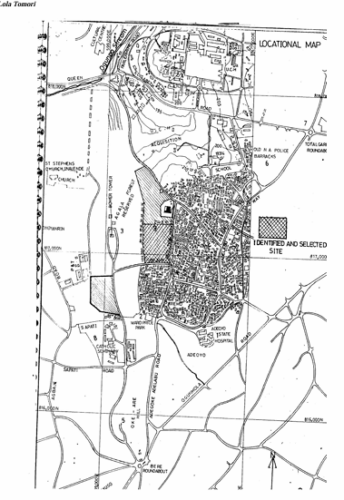
8.2. Site Selected For the New Olubadan Palace:
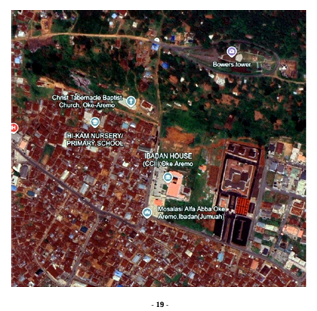
The Committee of five identified and selected the Oke-Aremo (Agala Forest Reserve) at the slope of the Bower’s Tower located on the highest point of Aare Hill, one of the range of hills that run from Mapo towards North-east-west of Ibadan and divide the city up to Mokola Hill.
His Excellency, Governor Olawuyi Kolapo Ishola granted a Certificate of Statutory Right of Occupancy (C of O) on the surveyed parcel of land at the slope of Aare Latosa Hill and below the Bower’s Tower monument Oke-Aremo area
covering 5.233 Hectares in favour of Ibadan Traditional Council. The C of O was registered as No. 4 page 24 in volume 32381 dated 13 October, 1993 with Survey Plan No. IB 1932.
8.3. The Old Ibadan and New Traditional Palaces
Like their Middle East precursors, Yoruba palaces were walled rectangular enclosures with one main gate in front. Both Olubadan Alli-iwo and Irefin Palaces are rectangular in appearances and consist of 2 to 3 core areas.The inner core area served as the palace which faced a larger inner court in Alli-Iwo’s palace which served as the festival palace. The last core area served as the Oba’s residence. The rigidity of the Irefin Palace Fencing wall portrayed the exclusiveness of the Oba’s of yester years.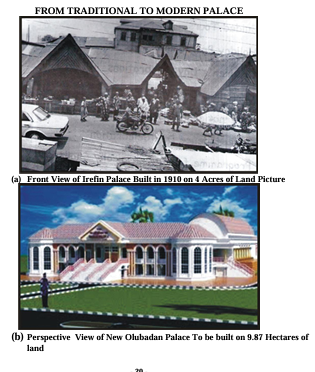
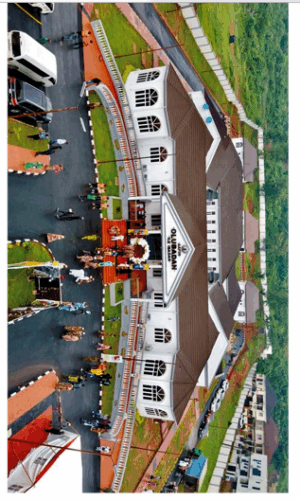
The palaces of Alli-Iwo and Irefin portrayed the African architecture in its originality which has been in existence before the proliferation of the Western civilization.
However, Balogun Adebisi’s Palace was a classic example of the early thirties in Yorubaland as a result of cultural transformation. Similar architectural features of the building could be noticed in few notable structures in Ibadanland. The buildings are the Oke-Are court house, the Agbaje Family Palace and the Mopo Hall to anme a few. These English Architecture, seconded to the Yoruba race were also available in other Yoruba cities, like Atiba hall in ancient Oyo town and Ilesha City Hall.
8.4. The Concept of the New Olubadan Palace
The palace site is at the foot of the rugged Shapati Hill which occupies the gently sloppy area of Agala Forest Reserve. The critical analysis of the natural and man-made physical development constraints showed that the site is free from any serious constraints which may limit urban developments, the like of Olubadan Palace Complex and Ibadan House.
The inadequacies of the first central palace built for Olubadan at Oja’-ba are as follows
(a) That it is rather choky for present day usage and because of constraint of
space, it has no room for expansion.
(b) That there is no open space for ceremonies and other out-door activities.
(c) That the environment falls short of a befitting Palace of the most
populous, indigenous African city.
8.5. The Land-Use Analysis
From the viewpoints of location, adjoining properties, site coverage (about 9.87 Hectares) accessibility, existing/proposed infrastructural services, security, centrality of the site to the Ibadan indigenous population, land morphology, natural man-made physical development constraints and the location was found suitable for the construction of the New Olubadan Palace Complex.
The Olubadan Palace Project will consist of the following
* Residential Area
* Royal Guest House
* Ceremonial Pavilion
* Reception Block
* Main Gate House
* Festivities Ground
* Car Parks
* Palace Transport Pool`
* Power House
* Police Post
* Fire Station
* Wood Land
* Existing Ibadan House
* Olubadan Market (Oja’ba)
* Future Development
* Gate House
Thus the modern Olubadan Palace Complex Buildings provide both office and residential accommodation including other infrastructure, and services that would befit the social and political status of the monarch in conformity with the
prevailing physical and cultural transformation.
NOTE: – The writer was the Secretary of the Olubadan Palace Site Selection
and Appraisal Committee (SSAC) set up by the Central Council of Ibadan Indigene
(CCII) in 1993 under the Chairmanship of Chief (TPL) Late Chief Dosu Babatunde
and three other professionals.